
Career paths at str
Start With the Work
A career path at STR starts with a position that’s a good match to your abilities and runs from there through the career levels based on your interests.
Teams & Disciplines
Find where you fit.
Every team at STR works differently — different rhythms, different tools, different mixes of research and delivery. Here’s what it actually looks like to work in each one.
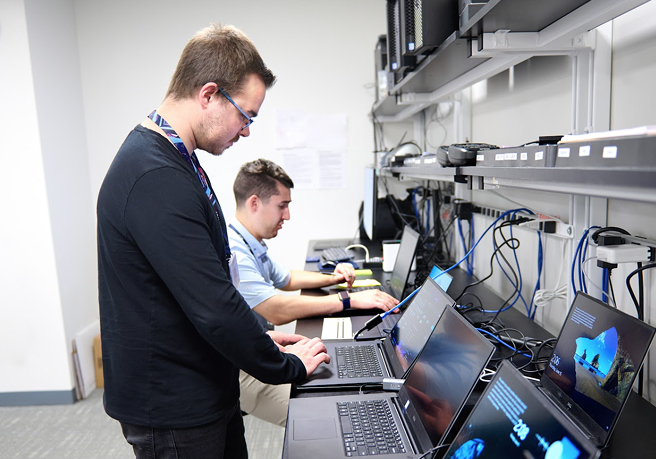
Build the systems that go to the field.
Engineers at STR own their work end-to-end — from architecture decisions to field deployment. You’ll collaborate closely with researchers and program leads, but when the system ships, your fingerprints are on it. Lorem ipsum dolor sit amet, consectetur adipiscing elit, sed do eiusmod tempor incididunt.
Ut enim ad minim veniam, quis nostrud exercitation ullamco laboris nisi ut aliquip ex ea commodo consequat. Lorem ipsum dolor sit amet.
Build the systems that go to the field.
Engineers at STR own their work end-to-end — from architecture decisions to field deployment. You’ll collaborate closely with researchers and program leads, but when the system ships, your fingerprints are on it. Lorem ipsum dolor sit amet, consectetur adipiscing elit, sed do eiusmod tempor incididunt.
Ut enim ad minim veniam, quis nostrud exercitation ullamco laboris nisi ut aliquip ex ea commodo consequat. Lorem ipsum dolor sit amet.
Build the systems that go to the field.
Engineers at STR own their work end-to-end — from architecture decisions to field deployment. You’ll collaborate closely with researchers and program leads, but when the system ships, your fingerprints are on it. Lorem ipsum dolor sit amet, consectetur adipiscing elit, sed do eiusmod tempor incididunt.
Ut enim ad minim veniam, quis nostrud exercitation ullamco laboris nisi ut aliquip ex ea commodo consequat. Lorem ipsum dolor sit amet.
Build the systems that go to the field.
Engineers at STR own their work end-to-end — from architecture decisions to field deployment. You’ll collaborate closely with researchers and program leads, but when the system ships, your fingerprints are on it. Lorem ipsum dolor sit amet, consectetur adipiscing elit, sed do eiusmod tempor incididunt.
Ut enim ad minim veniam, quis nostrud exercitation ullamco laboris nisi ut aliquip ex ea commodo consequat. Lorem ipsum dolor sit amet.
Build the systems that go to the field.
Engineers at STR own their work end-to-end — from architecture decisions to field deployment. You’ll collaborate closely with researchers and program leads, but when the system ships, your fingerprints are on it. Lorem ipsum dolor sit amet, consectetur adipiscing elit, sed do eiusmod tempor incididunt.
Ut enim ad minim veniam, quis nostrud exercitation ullamco laboris nisi ut aliquip ex ea commodo consequat. Lorem ipsum dolor sit amet.
Roles at STR
Find Where You Fit
Each role below describes the work, who you work with, and what we look for. Skim the taglines and read the ones that sound like you.
ENGINEERING ROLES
In this role, you’ll build the algorithms and systems that turn classified data—overhead imagery, communications, intelligence reports, sensor networks—into decision advantage. You’ll apply deep learning, computer vision, graph algorithms, reinforcement learning, and modern statistical methods to problems the commercial world does not see, on data the commercial world cannot access.
In this role, you’ll design the systems that turn a collection of platforms into a coordinated force. Your work—distributed mission planning, multi-agent task allocation, swarm coordination, kill-chain orchestration, contested-environment C2—spans teams of systems acting together, not single platforms acting alone. You’ll help build collaborative intelligence.
You’ll turn autonomy research into code that runs on real platforms. A planner that works in simulation is a paper; a planner that closes the loop under operational timing constraints is a capability. You’ll build the real-time control software, the C2 integration, and the simulation-to-reality path that gets an algorithm from a researcher’s laptop into the field.
Some targets can’t be studied directly—the hardware is scarce, unreachable, or classified, and is often coupled with its environment. You’ll give reverse engineers and vulnerability researchers high-fidelity models and emulations they can probe and instrument, so the team can work at a scale and pace that the real hardware would never allow.
In this role, you’ll build the pipelines that move robust software into the field quickly. You’ll automate build, test, security, and deployment so new capability reaches operators in days rather than months, with security built in from the start instead of bolted on at the end. This is software engineering practiced at velocity: the faster the mission needs to move, the more your pipeline matters.
You’ll develop approaches to make guarantees about code—proving that a program, or a patch to it, actually has the properties it claims. As AI systems learn to find and exploit vulnerabilities faster than people can analyze and patch them, the bottleneck is shifting to trust: can we be sure a fix is correct, and correct quickly enough to matter? You’ll build lightweight formal methods to answer that question at speed.
In this role, you’ll design the FPGAs, ASICs, mixed-signal boards, and RF front ends that form the hardware foundation for classified mission systems. Whether you’re building a high-performance beamformer, laying out a sensor receiver, or architecting an embedded real-time OS, your work moves from theory and simulation to lab validation to mission deployment. You make the algorithms real in hardware that must perform under pressure.
STR’s hardest problems don’t end when the algorithm works on the bench; they end when the integrated system holds up in a lab, on a range, under water or in the air. Integration and test engineers own that transition. You build the automated test frameworks, hardware-in-the-loop rigs, and field-trial campaigns that decide whether a capability is ready.
You’ll connect operational problems to engineered, fielded capability. You’ll move fluidly between analysis, software development, integration, and operations to turn promising technology into useful capability that supports a mission at the moment it’s needed.
In this role, you’ll treat the system itself as the artifact. You’ll build and own the model-based representation of a mission system—requirements, architecture, interfaces, and behavior captured in a live digital model rather than scattered across documents. Practiced with the rigor of software engineering, that model is what keeps hardware, algorithms, and software converging on one coherent design.
Product managers decide what gets built. In a company whose work starts as research, that means holding the line between what is technically possible and what the mission actually needs; shaping capability direction, sequencing what ships first, and staying close enough to operators that the answer is grounded in their problem rather than an assumption about it. This is a rapidly growing function, closer to the engineering than to marketing.
Program managers run classified and unclassified programs, holding the line on cost and schedule while staying close enough to the engineering to understand the implications of hard technical choices. Successful program managers either come from engineering or have built enough technical fluency to lead engineers credibly and make sound decisions under pressure.
You’ll figure out the intricacies of how undocumented software, firmware, and hardware targets work and build the tooling to do that work at scale. You’ll disassemble binaries, analyze instruction sets, recover protocols and state machines, and build AI-based automation that surfaces patterns no analyst could reliably spot by hand. You’ll turn opaque systems into understood ones, in tightly cleared environments against real targets.
In this role, you’ll design the algorithms that deliver overmatch in an increasingly contested spectrum. Your work—adaptive beamforming, multi-emitter localization, waveform design, RF threat emulation—moves from breakthrough idea to mathematical model to prototype to fielded hardware. You’ll help turn theory into deployed capability.
In this role, you’ll take algorithms from the research bench to the field. You’ll build the real-time signal-acquisition pipelines, embedded systems, and production software that turn radar or EO/IR data into information an operator can use. You work at the boundary between the algorithm researchers handing you prototypes and the customers who deploy your code. Your work is integration: signal processing chains, FPGA interfaces, hardware-coupled software, and the hardening required to move from lab to field.
In this role, you’ll work on some of the hardest physics and signal processing problems in the military space domain. You’ll build the payload algorithms, on-orbit processing, and ground-segment software that turn a satellite into a mission asset rather than just a bus. That includes space-based RF sensing, radiation- and power-constrained processing, real-time ground integration, and the satellite-to-ground links that carry mission intelligence home.
In this role, you’ll design the sonar systems, acoustic processing algorithms, and undersea sensor platforms that give operators a decisive advantage in contested waters. Your work, from beamforming and transducer arrays to seabed node deployments, bridges signal processing and hardware-coupled software. You’ll turn underwater physics into operational capability and test it where it matters—at sea.
In this role, you’ll hunt for the flaws that matter in software, firmware, and hardware—then prove them. You’ll take understood targets and probe them for weaknesses, develop proofs of concept and exploit chains, and reason about how a real adversary would chain small defects into mission impact. You’ll work at the intersection of offense and defense, in tightly cleared environments against real targets.
In this role, you’ll design the algorithms that deliver overmatch in an increasingly contested spectrum. Your work—adaptive beamforming, multi-emitter localization, waveform design, parameter estimation—moves from breakthrough idea to mathematical model to prototype to fielded hardware. You’ll help turn theory into deployed capability.
LEARN MOREIn this role, you’ll design the sonar systems, acoustic processing algorithms, and undersea sensor platforms that give operators a decisive advantage in contested waters. Your work—from beamforming and transducer arrays to seabed node deployments—bridges signal processing and hardware-coupled software. You’ll turn underwater physics into operational capability and test it where it matters: at sea, in the field.
LEARN MOREIn this role, you’ll work on some of the hardest physics and signal processing problems in the military space domain. You’ll build the payload algorithms, on-orbit processing, and ground-segment software that turn a satellite into a mission asset rather than just a bus. That includes space-based RF sensing, radiation- and power-constrained processing, real-time ground integration, and the satellite-to-ground links that carry mission intelligence home. This is how STR competes in orbit, not as an afterthought, but as a foundational growth area.
LEARN MOREIn this role, you’ll take algorithms from the research bench to the field. You’ll build the real-time signal-acquisition pipelines, embedded systems, and production software that turn radar or EO/IR data into information an operator can use. You sit at the seam between the algorithm researchers handing you prototypes and the customers who deploy your code. Your work is integration: signal processing chains, FPGA interfaces, hardware-coupled software, and the hardening required to move from lab to field.
LEARN MOREIn this role, you’ll design the FPGAs, ASICs, mixed-signal boards, and RF front ends that form the hardware foundation for classified mission systems. Whether you’re building a high-performance beamformer, laying out a sensor receiver, or architecting an embedded real-time OS, your work moves from theory and simulation to lab validation to mission deployment. You make the algorithms real in hardware that has to perform under pressure.
LEARN MOREYou’ll figure out the intricacies of how undocumented software, firmware, and hardware targets work and build the tooling to do that work at scale. You’ll disassemble binaries, analyze instruction sets, recover protocols and state machines, and build automation that surfaces patterns no analyst could reliably spot by hand. You’ll turn opaque systems into understood ones, in tightly cleared environments against real targets.
LEARN MOREIn this role, you’ll hunt for the flaws that matter in software, firmware, and hardware—then prove them. You’ll take understood targets and probe them for weaknesses, develop proofs of concept and exploit chains, and reason about how a real adversary would chain small defects into mission impact. You’ll work at the intersection of offense and defense, in tightly cleared environments against real targets.
LEARN MORESome targets can’t be studied directly—the hardware is scarce, unreachable, or classified, and is often coupled with its environment. You’ll give reverse engineers and vulnerability researchers high-fidelity models and emulations they can probe and instrument, so the team can work at a scale and pace that the real hardware would never allow.
LEARN MOREYou’ll develop approaches to make guarantees about code—proving that a program, or a patch to it, actually has the properties it claims. As AI systems learn to find and exploit vulnerabilities faster than people can analyze and patch them, the bottleneck is shifting to trust: can we be sure a fix is correct, and correct quickly enough to matter? You’ll build lightweight formal methods to answer that question at speed.
LEARN MOREIn this role, you’ll build the algorithms and systems that turn classified data—RF signals, overhead imagery, communications, intelligence reports, sensor networks—into decision advantage. You’ll apply deep learning, graph algorithms, reinforcement learning, and modern statistical methods to problems the commercial world does not see, on data the commercial world cannot access.
LEARN MOREIn this role, you’ll design the systems that turn a collection of platforms into a coordinated force. Your work—distributed mission planning, multi-agent task allocation, swarm coordination, kill-chain orchestration, contested-environment C2—spans teams of systems acting together, not single platforms acting alone. You’ll help build collaborative intelligence.
LEARN MOREYou’ll turn autonomy research into code that runs on real platforms. A planner that works in simulation is a paper; a planner that closes the loop under operational timing constraints is a capability. You’ll build the real-time control software, the C2 integration, and the simulation-to-reality path that gets an algorithm from a researcher’s laptop into the field.
LEARN MOREIn this role, you’ll build the pipelines that move robust software into the field quickly. You’ll automate build, test, security, and deployment so new capability reaches operators in days rather than months, with security built in from the start instead of bolted on at the end. This is software engineering practiced as a discipline of velocity and trust: the faster the mission needs to move, the more your pipeline matters.
LEARN MOREYou’ll build the operational, real-time C2 and mission-applications software that integrates outputs from sensing, EW, and analytics teams into something an operator actually uses. You’re the engineer who makes capability work at the moment it’s needed.
LEARN MOREIn this role, you’ll treat the system itself as the artifact. You’ll build and own the model-based representation of a mission system—requirements, architecture, interfaces, and behavior captured in a live digital model rather than scattered across documents. Practiced with the rigor of software engineering, that model is what keeps hardware, algorithms, and software converging on one coherent design.
LEARN MORESTR’s hardest problems don’t end when the algorithm works on the bench; they end when the integrated system holds up in a lab, on a range, under water or in the air. Integration and test engineers own that transition. You build the automated test frameworks, hardware-in-the-loop rigs, and field-trial campaigns that decide whether a capability is ready.
LEARN MOREProgram managers run classified and unclassified programs, holding the line on cost and schedule while staying close enough to the engineering to understand the implications of hard technical choices. Successful program managers either come from engineering or have built enough technical fluency to lead engineers credibly and make sound decisions under pressure.
LEARN MOREProduct managers decide what gets built. In a company whose work starts as research, that means holding the line between what is technically possible and what the mission actually needs; shaping capability direction, sequencing what ships first, and staying close enough to operators that the answer is grounded in their problem rather than an assumption about it. This is a rapidly growing function, closer to the engineering than to marketing.
LEARN MOREOPERATIONS ROLES
This team runs the financial engine of active programs and of the company itself: program financial analysis, FP&A, general ledger accounting, accounts receivable and payable, payroll, internal audit, and internal controls. In a DCAA-audited cost-accounting environment, precision is not optional. The numbers have to be right, defensible, and on time.
You’ll build and maintain relationships across business operations to enable the work of an engineering division. Business analysts interact with project finance to plan projects and forecast results; laboratory managers run the labs with the discipline of an operating business. This is a bridge function, close to both the engineering divisions and business operations.
This team turns opportunities and proposals into awarded vehicles and then into funded, executable work—negotiating and managing prime contracts, subcontracts, procurement, and government property through strong customer and supplier relationships. In addition, the team provides critical guidance and input to manage execution risk through robust compliance and change management.
Classified technical work needs real physical infrastructure: accredited spaces, functioning labs, and safe buildings. This team coordinates facilities operations, manages construction and build-out projects, keeps building systems running, and owns environmental health and safety across STR’s sites. The work is practical, visible, and essential.
Hiring for classified technical work is its own challenge: the most interesting projects are the least describable, and cleared talent is scarce. This team owns the full people lifecycle—talent acquisition and recruiting, HR business partnering, learning and development, benefits, compensation, and employee engagement—for a workforce of engineers and scientists doing work they often cannot fully talk about.
Classified technical work needs strong security to protect people, information, programs, and capabilities. This team manages industrial, program, personnel, physical, information, and cybersecurity requirements; protects classified systems and spaces; and partners with technical teams to enable secure operations, new programs, and business growth. The work is collaborative, mission-focused, and essential to STR’s ability to do its most important work.
STR’s Information Technology & Enterprise Cybersecurity team is responsible for building, operating, and securing the technology environments that enable our people to do their most important work. From enterprise infrastructure and end-user technology to classified systems, networking, and cybersecurity, our teams make sure STR’s technology is reliable, secure, resilient, and ready for the mission.
Pricing is a distinct discipline from accounting. Accountants manage the money on contracts we already hold; pricers build the cost volumes that help win the next one. This small, high-leverage team develops pricing strategy and cost estimates for competitive government proposals, models scenarios, and works the line between what is compliant, what is competitive, and what is executable.
Government contracts do not administer themselves. This team turns awarded vehicles into funded, executable work: negotiating and administering prime contracts and subcontracts, running procurement and supplier management, and keeping government property accountable to the letter of the regulation. The work is exacting because the customer is the U.S. government and every action has to withstand DCAA and DCMA scrutiny.
LEARN MOREThis team runs the financial engine of active programs and of the company itself: program financial analysis, general ledger accounting, accounts receivable and payable, payroll, internal audit, and internal controls. In a DCAA-audited cost-accounting environment, precision is not optional. The numbers have to be right, defensible, and on time.
LEARN MOREPricing is a distinct discipline from accounting. Accountants manage the money on contracts we already hold; pricers build the cost volumes that help win the next one. This small, high-leverage team develops pricing strategy and cost estimates for competitive government proposals, models scenarios, and works the line between what is compliant, what is competitive, and what is executable.
LEARN MORESTR runs both an enterprise IT environment and classified networks, and both have to stay up, stay secure, and stay usable. This team administers systems and networks, supports users across every site, manages endpoints and identity, and keeps the infrastructure behind the mission healthy, including the accredited classified systems that make STR’s work possible.
LEARN MOREThis is program-protection and information-system security, not the offensive or defensive cyber engineering STR delivers to customers. The team accredits information systems under RMF, runs facility and program security under NISPOM, manages personnel security and clearances, and establishes the physical and program protections that classified contracts require. This is the function that allows STR to hold classified work at all.
LEARN MOREClassified technical work needs real physical infrastructure: accredited spaces, functioning labs, and safe buildings. This team coordinates facilities operations, manages construction and build-out projects, keeps building systems running, and owns environmental health and safety across STR’s sites. The work is practical, visible, and essential.
LEARN MOREYou’ll build and maintain relationships across business operations to enable the work of an engineering division. Business analysts interact with project finance to plan projects and forecast results; laboratory managers run the labs with the discipline of an operating business. This is a bridge function, close to both the engineering divisions and business operations.
LEARN MOREHiring for classified technical work is its own challenge: the most interesting projects are the least describable, and cleared talent is scarce. This team owns the full people lifecycle—talent acquisition and recruiting, HR business partnering, learning and development, benefits, compensation, and employee engagement—for a workforce of engineers and scientists doing work they often cannot fully talk about.
LEARN MOREFrequently asked Questions
Questions About Interviewing
You can apply directly through our Careers page. Select a role, click “Apply,” and complete the online application form. Please upload your resume/CV and any documents (e.g., cover letter).
Not necessarily. Many roles benefit from prior defense or government experience, but we also hire from commercial tech and other industries. The key is relevant skills (e.g., software, hardware, systems engineering, program management, operations, etc.).
No. You can apply without an existing clearance.
— Some roles require you to be eligible for a clearance (typically U.S. citizenship and background requirements).
— If a clearance is required, the job posting will state this.
— For certain positions, we may sponsor and support you through the clearance process after hire.
Yes. At this time, we hire only domestically within the U.S. Roles will specify the primary work location and whether remote or hybrid work is possible.
Each job posting will indicate the expected arrangement. Work arrangements depend on the role and program:
Onsite: Many positions require onsite work at secure facilities or labs.
Hybrid: Some roles allow a mix of onsite and remote work.
Remote: Limited roles may be fully remote, where security and program requirements permit.
You’ll receive a confirmation email. Our recruiting team and hiring managers review applications and contact candidates whose experience closely matches the role. If you are selected to move forward, we’ll outline the next steps in the process at that time.
Timelines vary by role and clearance requirements. Roles requiring a new or upgraded security clearance may have additional steps after hire.
Yes. You’re welcome to apply for any roles that match your skills and interests. We recommend tailoring your resume to each position and focusing on roles that best align with your background.
If you meet most of the core requirements and believe you can succeed in the role, we encourage you to apply. For some positions, certain requirements (e.g., U.S. citizenship, clearance eligibility, specific certifications) are mandatory due to contract or regulatory obligations.
Please see our Benefits page.
Yes, please visit our Internships page.
While it varies by role, most candidates can expect:
— An initial phone or video screening with a recruiter
— One or more interviews with the hiring manager and team (virtual or onsite)
— For technical roles, a skills assessment, coding exercise, or technical discussion
— For certain positions, additional steps related to security or compliance
— We’ll share specifics once you’re invited to interview.
We recommend:
— Reviewing the job description and our website, including our products, mission, and customers
— Preparing examples of past work that demonstrate your technical and problem-solving skills
— Being ready to discuss working in a regulated, mission-focused environment
— Preparing questions about the role, team, and programs you may support
Due to the nature of our work and security requirements, most roles require U.S. citizenship, and so we do not sponsor work visas. Each job posting will indicate citizenship and clearance requirements.
We do our best to respond, but high application volumes can cause delays. If it’s been more than three weeks, you’re welcome to follow up via str-recruiting@str.us with the role title and date you applied.
Yes. We may consider your profile for other roles that match your experience. You can also set up job alerts on our Careers page to be notified of new openings.
Open JOBS
See all the positions
Browse every open position across all capability areas
and all U.S. locations